
Who Rules — and Who Rewrites the Story
Every regime tells a story about itself. The durability of that regime depends, in no small part, on whether the story is true — and on who is permitted to tell it.
Two recent white papers, taken together, expose a quiet transformation of the American story that operates on two fronts simultaneously. The first, by Jeffrey H. Anderson and John Fonte, investigates how the National Park Service has systematically recast the founders of the American republic — at the very monuments built to honor them — from statesmen into defendants. The second, from Scott Rasmussen and the Napolitan Institute, provides the survey data that explains why: the people who control America’s institutions hold views so far removed from the citizens they ostensibly serve that the gap can no longer be described as mere disagreement. It is a difference of premise.
Read them together. The picture is clarifying.
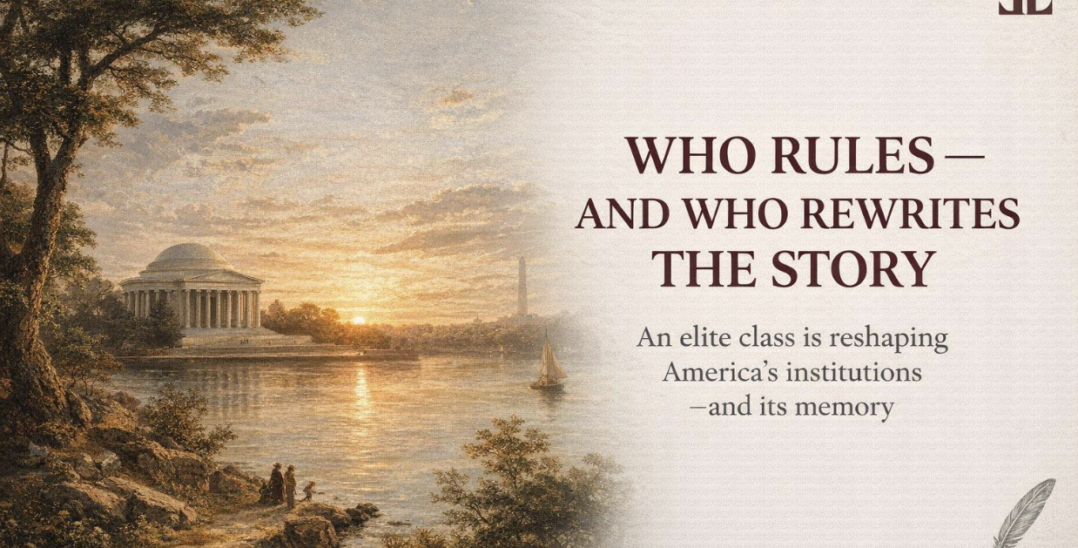
Begin where Americans have always begun — at the monuments. Anderson and Fonte document, with careful evidentiary rigor, what has happened to the sacred civic spaces where the nation narrates its founding. At Independence Park in Philadelphia, twenty-five of thirty interpretive signs at the President’s House site now center on slavery. At the Jefferson Memorial, a basement museum that once presented the author of the Declaration through his own luminous words is being redesigned as something closer to a prosecution brief. The man who articulated the principle of human equality will be reintroduced to visitors primarily as an “enslaver” — a term deliberately chosen, as Fonte observes, to collapse the moral distinction between slaveholding and slave-trading, erasing every consideration of context, conscience, and the founders’ own movement toward abolition.
The Smithsonian, which draws sixty-two percent of its operating revenue from federal taxpayers, has become the institutional center of gravity for this transformation. Under Secretary Lonnie Bunch, the institution has embraced a social-justice mandate that treats the American past not as a complex inheritance requiring interpretation but as an indictment requiring confession. Underwriting much of this effort: a $500 million commitment from the Andrew W. Mellon Foundation to reshape the nation’s commemorative landscape — prioritizing demographic representation among the memorialized over recognition of the achievements that built the civilization those memorials adorn.
This is not enriched scholarship. It is narrative replacement conducted through curatorial authority.
Now consider the sociology, because the data reveals the class interest behind the project.
Rasmussen’s Napolitan Institute research identifies what it terms the “Elite 1%” — Americans holding postgraduate degrees, earning above $150,000, and residing in dense urban zip codes. They constitute roughly one percent of the population. Their institutional influence is vastly disproportionate. And their convictions represent a near-perfect inversion of mainstream American belief.
The figures are bracing. Forty-seven percent of the Elite 1% maintain that Americans enjoy too much individual freedom. Seventy percent express trust in the federal government, against twenty-two percent of voters nationally. More than three-quarters favor prohibiting private gun ownership. Most revealing: federal government managers — the unelected administrators who operate the permanent machinery of the state — align more closely with the Elite 1% than with the public whose laws they execute.
This is not a disagreement about policy. It is a divergence about the nature of the regime itself. One America holds that self-government, individual liberty, and the founding settlement remain sound. The other holds that the founding was fatally compromised, that liberty without expert supervision is reckless, and that the public’s judgment is a problem to be managed rather than a sovereignty to be respected. The first America constitutes the country. The second administers its institutions.
What Anderson and Fonte document at the ground level — the patient, methodical revision of the American story at its most consecrated sites — Rasmussen quantifies at the population level. The relationship between the two is not coincidental. It is structural. The same narrow stratum that regards your liberty as excessive is the stratum staffing the agencies, endowing the foundations, and curating the exhibits that shape how the next generation understands its inheritance.
The Mellon Foundation did not consult the American public before committing half a billion dollars to reimagine the nation’s monuments. The National Park Service did not seek the consent of the governed before redesigning the Jefferson Memorial around the moral vocabulary of his critics. They did not need to. They occupy the commanding heights of institutional life, they share a coherent worldview, and they assumed — not unreasonably — that the public lacked the vocabulary and the venue to object.
That assumption is now being tested. These two reports, read side by side, supply both the vocabulary and the evidence. They demonstrate that the rewriting of America’s public memory is not the work of disinterested scholars pursuing uncomfortable truths. It is the product of a discrete class, identifiable by education, income, and geography, imposing its own ambivalent relationship with the American founding on a nation that does not share it.
Lincoln, in a different crisis, reminded Americans that public sentiment is everything — that with it, nothing can fail; against it, nothing can succeed. The architects of this transformation have labored for years on the assumption that public sentiment need not be consulted, only shaped. The evidence before us suggests they may have miscalculated.
